
Lessons from the Past: Why Everyone Needs to Care About One Health
The outbreaks of new diseases are changing the world as we know it, and therefore, nature-animals-humans have all become one. Recent scientific evidence reveals that more than 60% of contagious diseases have been transmitted from animals to people, and about 75% of newly identified diseases are animal origins. The Avian flu (H5N1), Nipah, SARS, MERS, Ebola virus, and COVID-19 are recent examples. In a nutshell, this article tries to explain what the “One Health” concept is and why it is important in these transitional times.

The Greek physician Hippocrates (c. 460 BC – c. 370 BCE), in his book “On Airs, Waters, and Places,” is credited with first recognizing how environmental elements might impact human health. He spread the notion that a clean environment is essential for maintaining public health. Human and animal medicine was used independently until the 20th century, despite the fact that scientists have been observing commonalities in illness processes between them since the 1800s. In the late 19th century, German physician and pathologist Rudolf Virchow (1821–1902) coined the term “zoonosis”, and said, “Between animal and human medicine there are no dividing lines – nor should there be”. In 1947, veterinarian James H. Steele furthered the concept in the U.S. by establishing the field of veterinary public health at the CDC. The phrase “One Medicine” was developed and promoted by Calvin W. Schwabe (1927–2006), a veterinary epidemiologist and parasitologist in his textbook “Veterinary Medicine and Human Health”. He created a department at the University of California, Davis to address concerns related to both human and animal health sciences.
In the middle of the 2000s, the H5N1 influenza outbreak caused widespread concern, prompting the American Medical Association to pass a One Health Resolution in 2006 and the American Veterinary Medical Association to create a task force for the initiative. This resolution calls for collaboration between veterinary and human medical organizations in 2007 and advised a One Health strategy to address global illness epidemics that year. In 2008, the Food and Agriculture Organization (FAO), World Organization for Animal Health (OIE), and World Health Organization (WHO) collaborated with UNICEF, United Nations System Influenza Coordination, and the World Bank to develop a framework titled “Contributing to One World, One Health-A Strategic Framework for Reducing Risks of Infectious Diseases at the Animal-Human-Ecosystems Interface,” reiterating the importance of these initiatives. The One Health Commission, One Health Platform, and One Health Initiative Team declared November 3 as International One Health Day in 2016.

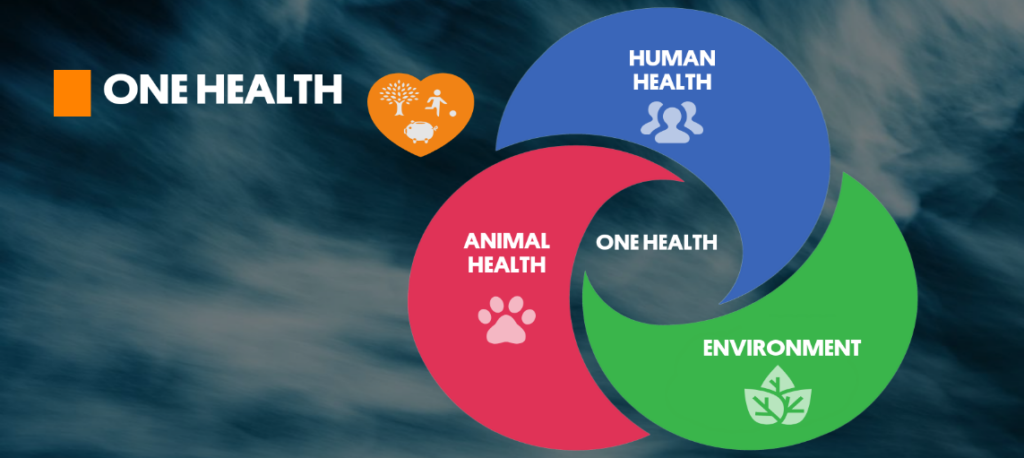
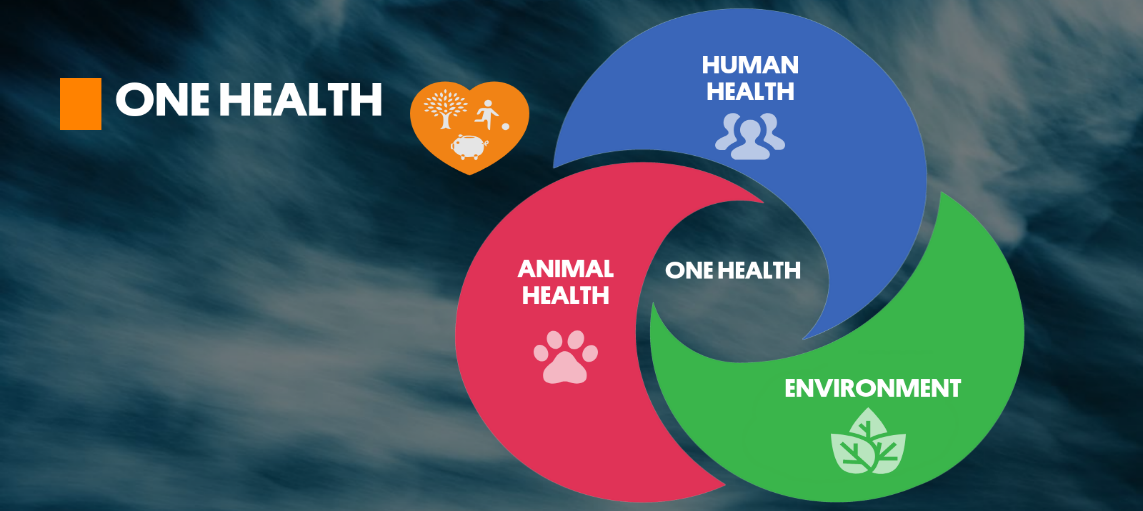
In recent years, the concept has gained more recognition in public health and animal health communities through the support of key individuals and important events. One Health concerns include zoonotic diseases that affect humans, animals, and the environment, neglected tropical diseases, vector-borne illnesses, antibiotic resistance, food safety and security, climate change, and other health challenges. More specifically, it is defined as “the collaborative efforts of multiple disciplines”—medical, veterinary, and research professionals, etc.- “working locally, nationally, and globally, to attain optimal health for people, animals, and our environment”. The human population is expanding and spreading. At present, many people have committed connections with their pets, cattle, and both wild and domesticated livestock. Animals are essential to our way of life in many ways, including companionship, food, fiber, livelihood, travel, sport, and education. When people are in close proximity to animals and their surroundings, diseases between humans and animals are likely to occur.

The Earth’s climate and land usage have changed as a result of deforestation and intensive farming practices. The ecology and habitat of an animal can be altered, which can open up new opportunities for disease. People, animals, and animal products are now more mobile in international trade and travel. Diseases can therefore spread quickly both inside countries and across international boundaries. The One Health approach can-Prevent outbreaks of zoonotic disease in animals and people, improve food safety and security, reduce antimicrobial-resistant infections and improve human and animal health, protect global health security, protect biodiversity and conservation. It is not only a successful strategy for solving health problems but also serves as a common language and unifying goal for different sectors and development agencies, resulting in greater improvements in human health and well-being than in the health sector alone. The post-Covid-19 recovery process offers countries the opportunity to propel themselves on a path of “green growth” that combines economic growth with environmental protection, slowing climate change and reducing the risk of future pandemics. In place of the present fragmented and uncoordinated system, one health should be created and it should be based on the concepts of integration, collaboration, joint ventures, and coordination. By promoting collaboration across all sectors, a One Health approach can achieve the best health outcomes for people, animals, and plants in a shared environment.
References
- https://www.cdc.gov/onehealth/basics/history/index.html#:~:text=Although%20the%20term%20%E2%80%9COne%20Health,separately%20until%20the%2020th%20century
- https://www.ocf.berkeley.edu/~ohsi/history-of-one-health-4/
- https://www.isglobal.org/en/healthisglobal/-/custom-blog-portlet/one-health-una-sola-salud-o-como-lograr-a-la-vez-una-salud-optima-para-las-personas-los-animales-y-nuestro-planeta/90586/0
- https://blogs.cdc.gov/global/2020/11/02/one-health-a-comprehensive-approach-to-preventing-disease-saving-lives/
- https://www.cgdev.org/blog/one-health-placing-human-animal-and-environmental-issues-heart-covid-19-recovery-asia-pacific
- Sikkema, R. S., & Koopmans, M. P. (2021). Preparing for emerging zoonotic viruses. Encyclopedia of Virology, 256.
- Aguirre, A. A., Beasley, V. R., Augspurger, T., Benson, W. H., Whaley, J., & Basu, N. (2016). One health—Transdisciplinary opportunities for SETAC leadership in integrating and improving the health of people, animals, and the environment. Environmental Toxicology and Chemistry, 35(10), 2383-2391.