
Stories from the Youth for climate resilient agriculture (YCRA) programme 2/8
Written by Wouter Geurts and Ohemaa Agbolosooh-Mensa (IAAS Alumni/mentor), Thomas Westhoff (IAAS)
In 2022, FAO and IAAS, in collaboration with YPARD, launched the Youth for Green and Climate-Resilient Agriculture (YCRA) Programme to support youth in their efforts to adapt to and mitigate the impacts of climate change in agriculture and the food system. Through a competitive application process, 8 youth-led projects working for greener and more resilient agrifood systems were selected. Throughout the year, the teams received capacity-building and mentoring to help them take their projects to the next level.
As the programme comes to an end, this series of articles will reflect on the progress and achievements of the 8 youth-led projects. This second article brings us to Ghana to meet Mathias Charles Yabe and Dhruvika Sosa, founders of AkoFresh, a mobile off-grid food preservation technology unit built to help smallholder farmers in Ghana reduce their post-harvest losses.

AkoFresh: a sustainable food preservation method for local farmers
According to the Food and Agriculture Organization of the United Nations (FAO), 14 percent of the food we produce is lost or wasted from post-harvest stages up to (but not including) the retail stage. Food loss and waste not only contribute to greenhouse gas emissions — when food ends up in a landfill, it generates methane, a greenhouse gas 25 times more potent than carbon dioxide— but is also a significant source of income loss for farmers.
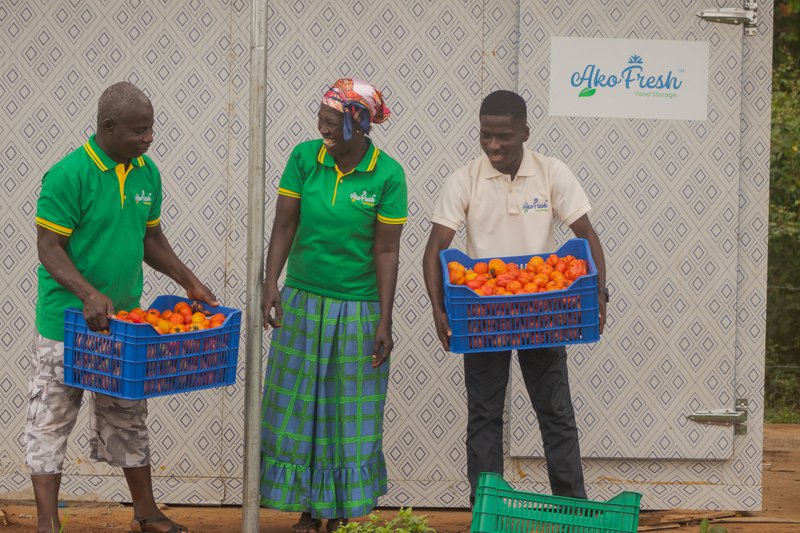
To tackle this issue, AkoFresh offers a green cold chain solution for smallholder farmers to help reduce postharvest losses, thereby creating lasting profits and reducing food waste carbon emissions. The innovation is a solar-powered cold storage preservation technology that extends the shelf life of perishable crops from 5 to 21 days.
‘It all started with us, getting together online during the 2020 lockdown’, explains Dhruvika Sosa, co-founder and sustainability strategist of AkoFresh . ‘Through a competition on the social network Fishbowl, our entrepreneurial team was formed. In 2018 our founder, Mathias Charles embarked on a volunteer trip that exposed him to the issue of post-harvest losses which was very detrimental to the people of Akumadan community in Ghana. He met a 56-year-old woman who took him around her farm, pointing out rotten tomatoes and sadly sharing how hard she had worked on her crops only to have 1/3 of them go to waste. When the team got together, AkoFresh was born as an intervention to postharvest losses. Now, the journey has continued with stops at COP27 in Egypt, Global Solutions Summit in Berlin, Prototypes for humanity in Dubai, and many contacts.’

The Innovation.
The innovation is a solar-powered cold storage preservation technology that extends the shelf life of perishable crops from 5 days to 21 days. Our off-grid cool boxes are temperature-controlled and operate between the temperatures of 4-15 degrees Celsius. This is a necessity to keep perishable food fresh from the farm to fork. This storage technology is helping farmers store perishable crops over five times longer than their shelf life in ambient temperatures and thus reduce losses.
Farmers appreciate our solution because it helps them extend the shelf life of their crops and reduce wastage. During the storage period, farmers will be able to find buyers or middlemen to sell their crops to. Due to this extended time not only would farmers be able to find someone to buy their products, but they can also use their time to ensure that the buyer is offering them a fair price.
To ensure and promote a more inclusive food system, the project proposes its cold storage technology as a service to communities, so that farmers do not need to pay the cost of the entire unit upfront. At this moment, the pilot cold unit is available to farmers in the Ashanti region, specifically the Akumadan community in Ghana .

A fast growing youth-led business
AkoFresh has been growing quickly in 2022. Mathias Charles Yabe, founder and CEO, looks back on his team’s work: “We completed the product development and built a network of eight local and global partners with a network of over 250 smallholder farmers for our community pilot. ” In January, the project was selected to be supported in the YCRA programme. This recognition of AkoFresh’s potential is far from being the only one: AkoFresh has received a total of eight international awards, including recognition from the World Economic Forum, Global Solutions Initiative, United Nations Office for South South Cooperation and TotalEnergies. Student Prize of the Varkey Foundation and the Young Global Changer Awards.
The capacity building from the YCRA has helped Mathias and his team with using risk assessment tools and developing a risk management model for AkoFresh. He and his team also worked on developing a robust project implementation plan with the help of their mentor, Mr. Wouter Geurts, an experienced engineer specialized in business development and alumnus of IAAS. Besides building its capacity, AkoFresh also gained a lot of visibility. Mathias was one of the two climate champions of the YCRA programme who were sponsored to attend COP27. This experience allowed to network with like-minded entrepreneurs and showcase the contribution of youth to current food challenges.
Earlier this fall, Mathias also participated in Junior World Food Day, where he called young people to action: “Although our current food systems fail to meet the needs of people and the planet, there are reasons to be optimistic about the future “Don’t let your background be a barrier, Let’s all take up the challenge to innovate and leave no one behind ” he said.
Conclusion: Stay fresh and keep on improving
For the future, Mathias and his team wish to tackle a new challenge: helping farmers get better access to markets while AkoFresh preserve their fresh farm products. The team is already working to ensure that their established network can also create opportunities for farmers so they can meet with potential buyers. On the technical side, AkoFresh is working to develop a next-generation cooling system to further improve their service with the help of their mentor, Mr. Geurts. They are planning to stay in close touch with him as they continue further on preventing food losses with their affordable solar-powered cooling system.
Both Dhruvika and Mathias are open for the idea to increase the level of interaction with local stakeholders such as the local IAAS teams in the countries of their activities. “The successful end of this phase of the project will be celebrated with the stakeholders involved, meanwhile we’re only at the start of a journey that will continue. The outreach to sponsors and the general interest in our venture is more than successful for this initial period, but to continue the journey, the team will have to grow and the value of interconnecting with IAAS and other stakeholders is of fundamental importance. “
The fresh horticultural value chain in Ghana is still far from solving its post harvests loss issues but with start-ups like AkoFresh a positive change can be seen in the near future. “We stand to respond to food insecurity in this challenging but inspiring moment in history to bring about ecosystems regeneration and livelihoods upliftment”, said Dhruvika. Like every other start-ups, funding plays a major role in implementation. Improved access to funding through donor support would enable AkoFresh to replicate its innovation across many farming communities in the Ashanti region and in Ghana as a whole. In addition, access to technical support and expertise is needed to further strengthen the product development.
For more information:
- Website of AkoFresh
- Webpage of the YCRA programme
- Webinar series: “Sprouting change: capacity-building for youth in green and climate-resilient agriculture”
- Junior World Food Day 2022
The State of Food and Agriculture 2019. Moving forward on food loss and waste reduction.